The Emperor
Tarot card meaning, upright and reversed.
The Emperor represents structure, authority, and discipline.
Reversed, The Emperor points to rigidity, control issues, and instability.
The Emperor upright meaning
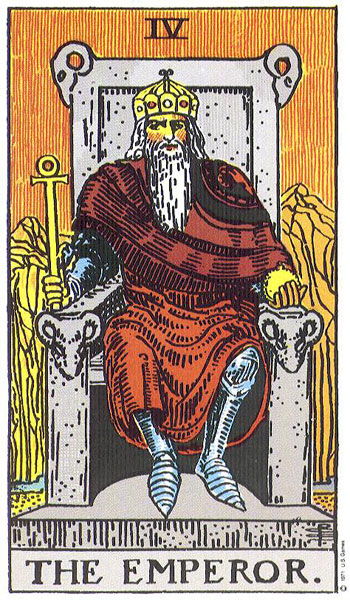
The Emperor sits on bare stone, not cushions, and the throne is carved with rams, the animal that meets a wall by lowering its head and going again. Behind him the mountains are dry and sharp, a landscape he did not soften but did learn to hold. Under the red robe there is armor, because his order was built by someone who remembers it can be lost. If something in your life is formless right now, this card says structure is not the cage, it is the wall that makes a room.
The Emperor reversed meaning
Reversed, the stone throne tips and the rams point at people instead of problems, structure hardened into a fist. Or the armor under the robe is doing the opposite job, guarding an insecurity rather than a kingdom. The mountains behind him are the same either way, indifferent to how tightly he grips. Loosen the hold enough to ask what the frame was actually built to protect.
AffirmationThe frame I build is the wall that makes a room, not a cage.
Where am I lowering my head like the ram at something that just needs a door?
Common questions about The Emperor
What does The Emperor mean in tarot?
The Emperor represents structure, authority, and discipline. The Emperor sits on bare stone, not cushions, and the throne is carved with rams, the animal that meets a wall by lowering its head and going again. Behind him the mountains are dry and sharp, a landscape he did not soften but did learn to hold.
What does The Emperor reversed mean?
Reversed, The Emperor points to rigidity, control issues, and instability. Reversed, the stone throne tips and the rams point at people instead of problems, structure hardened into a fist.
Is The Emperor a yes or no card?
It depends. The Emperor is balanced, so it answers with a question rather than a yes or no. Look at the cards around it and what you already feel.
Is The Emperor a Major or Minor Arcana card?
The Emperor is part of the Major Arcana. Its element is Fire / Aries. Number: 4.
How do you read The Emperor for self-reflection?
Read it as a mirror rather than a prediction, a prompt to think something through. A question to sit with: Where am I lowering my head like the ram at something that just needs a door?
Cards related to The Emperor
Where The Emperor sits on the Fool's Journey through the Major Arcana.
Want to actually learn the cards?
Auspice teaches you tarot one card at a time with spaced-repetition coaching, until you can read for yourself and for friends. Reading is reflection here, never fortune-telling.
New to tarot? Start with the beginner’s guide to reading tarot.