Four of Swords
Tarot card meaning, upright and reversed.
Four of Swords represents rest, recovery, and stillness.
Reversed, Four of Swords points to burnout, restlessness, and forced rest.
Four of Swords upright meaning
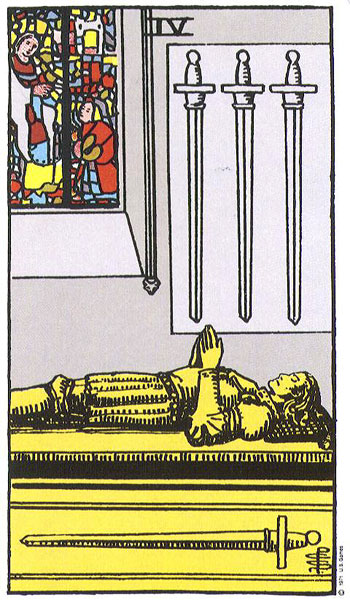
The Four of Swords lays a knight out flat on a tomb like a carved effigy, hands folded, three swords hung on the wall above him and one resting beneath, all of them sheathed of purpose for now. This is not death; it is a deliberate lying-down, rest taken on purpose in a quiet chapel. Recuperation here is part of the work, not a detour from it. Let yourself be as still as the figure, without guilt, and let the three swords stay on the wall.
Four of Swords reversed meaning
Reversed, the knight begins to rise off the tomb, and the question is whether the rest was actually finished, or cut short and dragged back into motion too soon. The three swords are still on the wall, still waiting. Skipped recovery tends to show up later as burnout. Give the stillness the full time it needs before you reach for a sword and stand up.
AffirmationI lie still on the tomb and let the swords stay on the wall.
Am I rising off the tomb before the rest was actually done?
Common questions about Four of Swords
What does Four of Swords mean in tarot?
Four of Swords represents rest, recovery, and stillness. The Four of Swords lays a knight out flat on a tomb like a carved effigy, hands folded, three swords hung on the wall above him and one resting beneath, all of them sheathed of purpose for now. This is not death; it is a deliberate lying-down, rest taken on purpose in a quiet chapel.
What does Four of Swords reversed mean?
Reversed, Four of Swords points to burnout, restlessness, and forced rest. Reversed, the knight begins to rise off the tomb, and the question is whether the rest was actually finished, or cut short and dragged back into motion too soon.
Is Four of Swords a yes or no card?
It depends. Four of Swords is balanced, so it answers with a question rather than a yes or no. Look at the cards around it and what you already feel.
Is Four of Swords a Major or Minor Arcana card?
Four of Swords is part of the Minor Arcana, Suit of Swords. Its element is Air. Number: 4.
How do you read Four of Swords for self-reflection?
Read it as a mirror rather than a prediction, a prompt to think something through. A question to sit with: Am I rising off the tomb before the rest was actually done?
Cards related to Four of Swords
Four of Swords read alongside its numerology siblings and suit neighbours.
Want to actually learn the cards?
Auspice teaches you tarot one card at a time with spaced-repetition coaching, until you can read for yourself and for friends. Reading is reflection here, never fortune-telling.
New to tarot? Start with the beginner’s guide to reading tarot.